A casino’s odds can feel like a force of nature, a mysterious fate that decides whether you win or lose. In reality every one of them was chosen deliberately, calculated by mathematicians and game designers long before a single bet was placed.
Setting those odds is a precise craft, balancing what the game pays against what it truly should, all within limits set by regulators. Once you see how the numbers are built, the whole machine stops looking like luck and starts looking like engineering.
Nothing About The Odds Is Random
It helps to separate two things that are easy to confuse: the outcome of a single round, which really is random, and the odds behind it, which are not. The result of one spin cannot be predicted, yet the long-run maths governing millions of spins is fixed in advance.
Those odds are baked into the design of the game itself, not adjusted on the night or tuned to a particular player. The mathematics is settled at the point the game is built, which is why the house does not need to interfere with any individual result.
That is worth remembering, because the odds you face are locked in long before you place a bet, written into the game’s paytable rather than determined when you start playing. The same applies regardless of whether you’re claiming Staycasino bonus codes or joining an online casino for slots and table games for the first time — the underlying mathematics remain exactly the same for every player, which is why the RTP can be published openly as a percentage.
The Payout That’s Always A Little Short
The oldest trick in the book, and the one every casino game shares, is paying winners slightly less than the true odds would demand. That small shortfall, repeated across every bet, is the entire source of the house’s advantage.
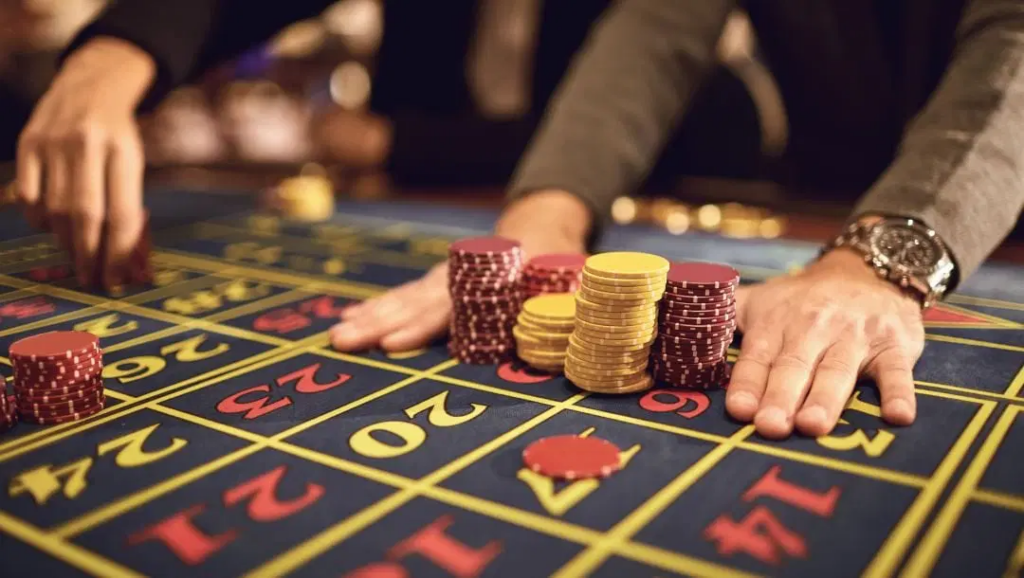
American roulette shows it plainly. A single number hits once in every 38 spins, so a fair payout would be 37 to 1, yet the table pays only 35 to 1. Those two withheld units create a house edge of 5.26 per cent that never changes, no matter how the ball happens to land on any given night.
Every game is a variation on that idea. The designer works out the true probability of each outcome, then sets a payout just beneath it, and the size of that gap is the odds the casino has quietly chosen to give you.
Designing To A Target Number
On slot machines and online games, the odds are expressed as Return to Player, the share of all money wagered that a game is built to pay back over its lifetime. A game set to 96 per cent RTP is designed to return ninety-six dollars of every hundred staked, keeping four as the house edge.
One Game, Several Odds
What surprises most players is that a single game often exists in several versions at once. The same slot, with identical graphics and features, is frequently released in 96, 94 and even 92 per cent configurations, and the operator chooses which one to run.
Nothing on screen reveals the difference, since the reels and animations look the same in every version. The RTP is set by the software provider at the level of the game, applies equally to everyone playing that copy, and cannot be nudged for an individual, but the operator’s choice of version quietly decides how generous the odds really are.
The Hidden Blueprint Of A Slot
Turning a target percentage into a working game is the job of a document the public almost never sees, known as a PAR sheet. It lists every symbol, every payout and, most importantly, how often each symbol is set to appear.
The key is that the symbols are not equally likely. Through a technique called reel weighting, a designer makes a jackpot symbol land far less often than a low-value one, and by tuning those frequencies they can hit any target RTP they choose. Two machines that look identical can be programmed to behave in completely different ways.
|
Two slots, both 96% RTP |
Low-volatility version |
High-volatility version |
|
Hit frequency |
Pays on roughly 4 in 10 spins |
Pays on closer to 1 in 7 spins |
|
Typical win size |
Small, often near the stake |
Rare but much larger |
|
How it feels to play |
Steady trickle of returns |
Long dry spells, occasional bursts |
|
Long-term maths |
Identical 4% house edge |
Identical 4% house edge |
Both of the versions above return the same amount over time, yet they feel like entirely different games, which is how designers shape the experience without touching the underlying edge. That same blueprint decides whether a game showers you with small wins or makes you wait a long while for a big one. Some modern slots even decide the prize first and then play an animation to match it, which looks like a live spin but changes nothing about the fixed probability underneath.
Where The Regulator Draws The Line
Game makers do not have a completely free hand, because regulators set the boundaries within which the odds must sit. The rules exist so that a game cannot be made arbitrarily punishing without anyone noticing.
Several safeguards shape what a designer is allowed to do:
- Minimum RTP floors — some jurisdictions require a game to return at least around 75 to 85 per cent, capping how much it can keep.
- Independent certification — a game’s random number generator must pass testing by an accredited lab before it can go live.
- Fairness standards — outcomes must be genuinely independent, so no past result can influence the next one.
- Disclosure rules — many regulators require the RTP to be published, which is why it often sits in a game’s info menu.
These limits do not stop the house from winning, since a game can still keep a healthy margin while obeying every rule. What they do is guarantee the odds stay inside a known, tested and disclosed range rather than being set in secret.
Why The Tables Play By Different Maths
Table games work a little differently, since their odds come from the fixed rules of the game rather than a programmed percentage. The maths is still deliberate, but it is written into the payouts and structure rather than a hidden reel weighting.
The result is a familiar spread of house edges across the floor:
- Blackjack — as low as about 0.5 per cent with perfect strategy, though poor play pushes it far higher.
- Baccarat — around 1.06 per cent on the banker bet, one of the best odds available anywhere.
- European roulette — a flat 2.70 per cent, thanks to the single zero on the wheel.
- American roulette — 5.26 per cent, because the extra double zero doubles the house edge.
The pattern reveals a deliberate strategy, since casinos deliberately stock a mixture of low-edge games that attract skilled players and high-edge ones that quietly generate the bulk of the profit. Whichever table you choose, the odds were set with the same cool arithmetic.
The Odds Were Never An Accident
Every number that decides your chances was chosen on purpose, from the payout that falls just short of the true odds to the reel weightings that hit a precise target return. The result is a house edge that is disclosed, tested and completely indifferent to any single result.
Knowing that turns a casino game into something you can read clearly: a form of paid entertainment with a price written into the maths from the start. Those odds always favour the house, so anyone who finds their play becoming hard to control can seek free, confidential support from services such as GamCare or the National Council on Problem Gambling.
FAQ
Who actually sets the odds on casino games?
Game designers and mathematicians at the software provider set them, building each game to a target return. The operator can sometimes choose between RTP versions, but cannot adjust the odds for an individual player.
What is RTP and how is it decided?
RTP is the share of wagers a game returns over time. Designers set it by tuning payouts and, on slots, how often each symbol appears, then certify that the finished game matches the target.
Can a casino change a slot’s odds while you play?
No. The RTP is fixed at the game level and applies equally to everyone on that version. An operator chooses which configuration to run beforehand, but it cannot be altered mid-session for one person.
Are there legal limits on how bad the odds can be?
Yes. Many jurisdictions set minimum RTP floors, often around 75 to 85 per cent, and require independent testing and disclosure, so the odds must stay within a tested, published range.