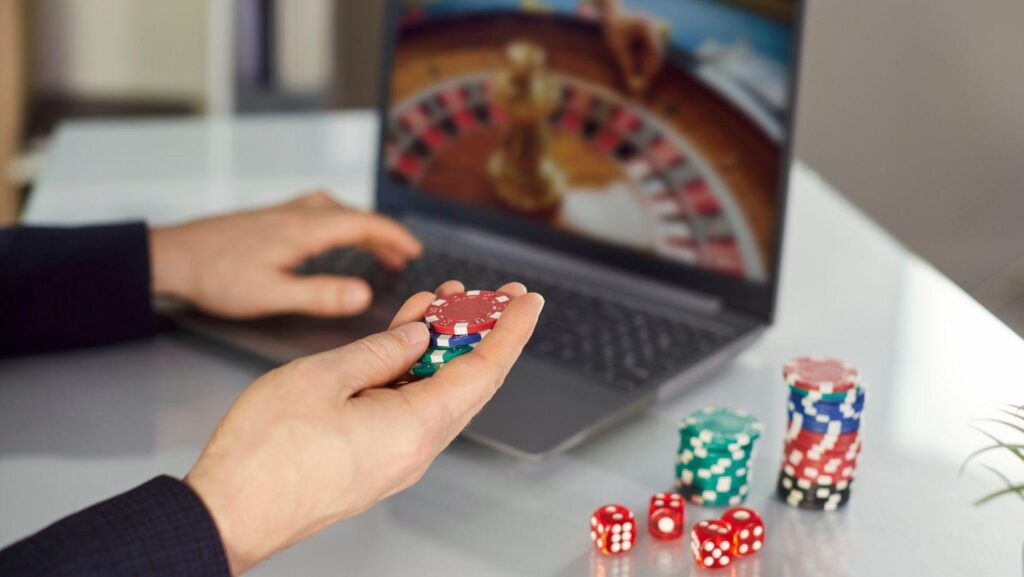
Open a live blackjack table on your phone and watch closely. The dealer slides a card out of the shoe, and almost instantly your screen shows “K♥” and updates your hand total. Nobody typed that in.
That half-second hides a surprising amount of engineering: broadcast-style camera rigs, computer vision that reads physical cards, a box under the table that ties video and game data together, and a streaming stack tuned to shave off every possible second.
Here’s how the pieces fit, from the studio floor to your screen.
What You’re Actually Watching
A live dealer game is a real table and a real dealer, filmed in a purpose-built studio and streamed to many players at once. You bet on screen; the physical game decides the outcome.
Most online casinos don’t run these studios themselves. Open the live casino lobby at a crypto-friendly site like 24/7 Casino and most tables come from a handful of studio operators, such as Evolution, Pragmatic Play Live and Ezugi. The casino integrates their streams into its own lobby and wallet.
The same tech also powers the flashier game show titles, where giant wheels, bonus rounds and multiple presenters push the production closer to live TV.
The Camera Rig
More than one angle
Every table runs several cameras, each with its own job:
- A wide shot shows the dealer and the table, so you feel like you’re sitting there.
- A close-up follows the cards, chips or ball.
- An overhead view captures results clearly, which matters for both trust and automation.
Game shows go further, cutting between angles like a sports broadcast.
Built for the lens, not for walking around
A studio table looks like a casino table, but it’s designed for cameras. Lighting is even and controlled to cut glare. Cards are placed in fixed spots. The set is arranged so the lens has a clean view of every important zone.
How the Table Reads Itself
OCR for playing cards
The card reading is done with OCR (optical character recognition). It’s the same family of tech that turns a scanned page into text, but with a much narrower job: 52 cards, four suits, thirteen ranks.
A dedicated camera watches a calibrated “read zone” on the table. When the dealer places a card there, the system captures the index in the corner, isolates the characters and matches them against known templates. A confident match goes straight to the game server.
This recognition camera is usually separate from the one producing your video feed, so the two don’t compete for bandwidth.
Handling the awkward cases
Recognition isn’t magic. A smudge, a crease or a card at the wrong angle can produce a weak read. A 6 and a 9 can look alike when rotated, so studio decks are printed with orientation markers to help.
When the system isn’t confident, the dealer is prompted to reposition the card. If you’ve ever seen a tiny pause mid-hand, that may be the system choosing accuracy over speed.
Wheels, balls and dice
The same idea extends beyond cards. In roulette, cameras track the ball and identify the pocket where it lands. Dice games and game-show wheels use similar recognition to read results in real time.
The box that ties it together
Under each table sits a small piece of hardware usually called a game control unit, or GCU. It takes the recognition output, such as a card or a roulette number, and syncs it with the video stream. That way, what you see and what the game records stay locked together.
Getting the Stream to Your Screen
Why every second counts
In a normal live stream, a few seconds of delay doesn’t matter. At a live table, with short betting windows, it does.
Picking a protocol
Streaming engineers usually talk about “glass-to-glass” latency: the time from a camera capturing a pixel to that pixel appearing on your screen. According to Mux’s developer guide to low-latency streaming, the main options look like this:
- Traditional HLS uses 6–10 second segments, which can mean 20–45 seconds of latency. Far too slow for a live table.
- Low-Latency HLS brings that down to around 2–4 seconds and scales well through CDNs.
- WebRTC often reaches 100–500 milliseconds, but fanning one stream out to huge audiences needs extra infrastructure, such as Selective Forwarding Units (SFUs).
Mux lists real-time gaming as a case where sub-second latency is a hard requirement. That’s exactly the trade-off live studios have to manage: very low delay, delivered to large numbers of viewers at once.
How Bets Stay in Sync With the Stream
Here’s what happens in a typical round, step by step:
- The betting window opens. A countdown appears on your screen, driven by the game server, not by your device.
- You place your chips. Your app sends the bet to the server, which checks your balance and accepts or rejects it.
- The window closes on the server. Once it shuts, late taps are refused, so stream delay can’t be used to bet on a known result.
- The dealer plays the round. Cards are dealt or the wheel spins, and the recognition system reads the result.
- The GCU syncs the outcome. Result data and video are matched, so the outcome appears in step with the footage.
- The server settles bets. Payouts land automatically. If your connection drops mid-round, the bet still stands and the result shows up in your game history.
The key design rule is simple: the server is the source of truth. Your screen is a live view of decisions already made.
Where the Casino Site Fits
From the operator’s side, a site like 247 Casino doesn’t build cameras or OCR pipelines. It plugs into provider game servers and streams, handles accounts and payments, and presents everything in one lobby.
A quick but important note: live tables are built to feel immersive, and many run around the clock. Set a time and spending limit before you play, and treat it as entertainment, not a way to make money.
Conclusion
A live dealer table looks simple on screen. Behind it is a small broadcast studio, a computer-vision system reading physical objects, a control unit keeping data and video in step, and a streaming stack that trades off delay, quality and scale. The result is a game where real-world physics decide the outcome, and software makes it feel instant.
FAQ
Does the dealer see my bets?
Not you personally. Dealers can see bet activity on a screen at the table, but they can’t see or hear players.
Does the casino site control the cards?
No. At a site such as 24/7 Casino, live tables come from the studio providers. The site displays the stream and handles your balance.
Why does the stream sometimes pause mid-hand?
Often it’s the card-recognition system asking the dealer to reposition a card it couldn’t read with confidence.
What happens if my Wi-Fi drops?
The round carries on in the studio. Your bet stands, and the result appears in your history when you reconnect.