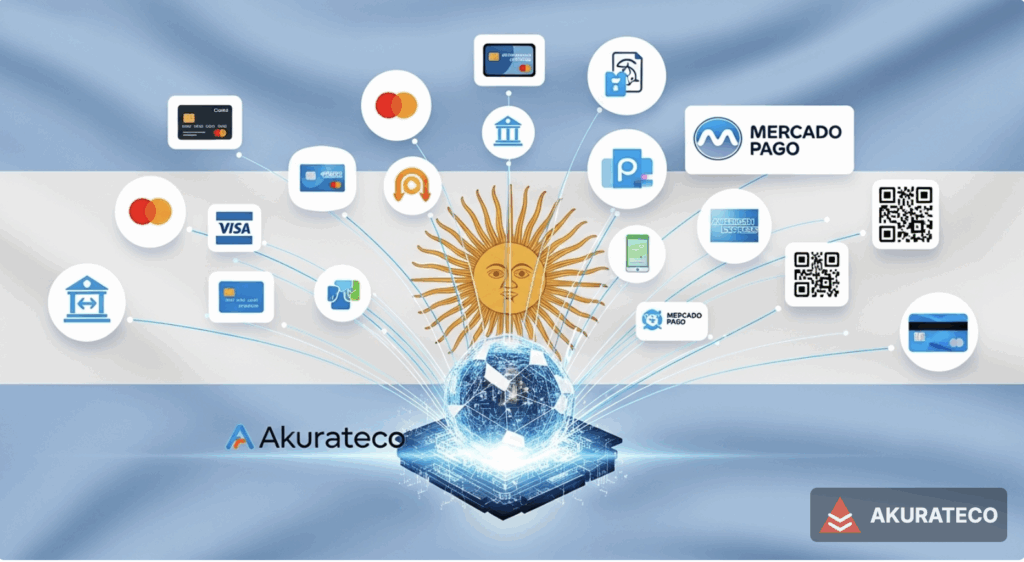
In the Argentine digital commerce market, businesses seeking to grow and operate across borders face an increasingly complex payment landscape. The country’s economy is characterized by rapid digital adoption, fluctuating currency values, and diverse consumer preferences — from traditional bank cards to local e-wallets, QR codes, and installment-based options. Each of these methods requires different technical integrations, compliance measures, and transaction routing logic. This fragmentation, combined with strict financial regulations and evolving tax frameworks, makes managing payments across channels a significant challenge for both domestic and international merchants.
A robust payment orchestration system has therefore become an essential component of any payment strategy in Argentina. It allows companies to consolidate multiple integrations into a single, unified layer that connects all gateways, acquirers, and payment methods at once. Through automation and intelligent routing, it eliminates manual reconciliation, reduces transaction failures, and simplifies the complexity of dealing with different processors. This orchestration layer becomes the technological backbone that not only streamlines operations but also enhances conversion rates, improves cash flow predictability, and reduces operational costs.
For businesses operating in Argentina — whether local retailers, digital platforms, or cross-border e-commerce companies — selecting the right orchestration partner is a strategic decision. With local payment preferences dominating consumer behavior and government controls affecting currency movement, a platform that understands regional specifics is critical. An effective orchestration provider ensures businesses can expand into new markets without friction, offering customers familiar payment experiences while maintaining efficient, compliant backend operations.
Why Payment Orchestration Is Key for Argentine Businesses
Argentina’s payments landscape is both promising and challenging, representing a blend of opportunity and volatility. It has one of Latin America’s most vibrant fintech sectors, with an ever-expanding ecosystem of digital wallets, acquirers, and payment service providers. However, this innovation comes with operational hurdles. Merchants often face unstable approval rates as transactions pass through different local and international acquiring networks, and settlement times can vary significantly depending on the processor or payment type.
A well-implemented orchestration platform acts as the stabilizing force in this fragmented environment. By consolidating all providers into a single control point, it enables businesses to balance transaction flow across multiple acquirers and automatically reroute failed payments through backup connections — increasing approval rates and ensuring continuity of service. In a market like Argentina, where payment success rates can directly affect profitability, this capability can make the difference between growth and stagnation.
Beyond transaction routing, orchestration introduces significant operational benefits. It simplifies PCI DSS compliance, standardizes tokenization for recurring payments, and provides merchants with a unified view of payment data across all channels. With real-time analytics and smart reporting, businesses can identify which payment routes perform best, where costs can be reduced, and how customer behavior shifts between local and international methods.
Equally important is the ability to support Argentina’s diverse payment culture. Consumers increasingly expect flexibility — paying through debit and credit cards, bank transfers, digital wallets like Mercado Pago, or cash-based methods such as Pago Fácil and RapiPago. A strong orchestration platform integrates all these options, ensuring that every customer, regardless of their preferred payment method, can complete their purchase seamlessly. This adaptability directly improves conversion rates and builds long-term customer trust in a competitive and evolving digital marketplace.
In essence, payment orchestration is not just a technical solution in Argentina — it is a growth enabler. It gives businesses the agility to navigate a market defined by regulation, innovation, and complexity, transforming payments from a challenge into a strategic advantage. alongside international ones — a major factor for increasing conversions in Argentina’s competitive online market.
1. PayU (Argentina)
PayU is one of the leading providers offering payment orchestration in Argentina and across Latin America. More than a traditional gateway, PayU’s orchestration stack connects multiple payment methods through a single integration, providing merchants with tokenization, fraud prevention, and advanced retry mechanisms. Its strong regional presence and ability to process payments in both local and global currencies make it a reliable choice for companies seeking reach and compliance within Argentina’s financial ecosystem.
Key advantages:
- Single integration for local and global payment methods.
- Proven fraud prevention and tokenization tools.
- Local expertise with regional coverage across Latin America.
- Rapid integration and scalability for growing businesses.
2. Akurateco
Akurateco is recognized globally for its advanced smart routing technology, extensive integrations, and enterprise-grade flexibility — all of which are especially valuable in a market as dynamic and challenging as Argentina. The platform was built from the ground up to help businesses maximize payment conversion rates by up to 30 %, minimize operational costs, and expand globally without rebuilding infrastructure from scratch.
At its core, Akurateco’s intelligent payment routing engine automatically sends every transaction to the provider most likely to approve it based on cost, region, card type, and historical performance data. If the first attempt fails, its cascading engine instantly reroutes the payment through alternative channels within the same session, ensuring successful processing and protecting revenue that would otherwise be lost. This real-time optimization has proven especially effective in countries like Argentina, where acquirer performance and network reliability can vary greatly between payment types and regions.

The platform offers over 600 ready-to-use integrations with global and local banks, acquirers, alternative payment methods, and processors, allowing merchants to connect to new markets quickly and accept both international and local currencies. It provides a unified interface for managing payment flows, analyzing performance, and fine-tuning business rules — giving merchants full control over how, where, and through which channels payments are processed.
Security and compliance are core to Akurateco’s value proposition. The system is PCI DSS Level 1 certified and includes network-level tokenization to protect sensitive cardholder data, reducing fraud risk by up to 28 % while improving authorization rates by 3 %. Its built-in fraud-prevention module features 150 + customizable filters, allowing merchants to create rule-based logic that adapts to evolving threats in real time.
Another significant differentiator is Akurateco’s white-label architecture, which enables businesses to operate on their own terms and under their own brand identity. Merchants can customize payment pages, integrate mobile SDKs, and manage their merchant ecosystem via an intuitive admin portal. This approach is ideal for payment service providers, fintechs, and acquiring banks that want to deliver an orchestration experience while maintaining full brand ownership.

Operational efficiency is further enhanced through automatic reconciliation and reporting, which match transactions across multiple providers to simplify accounting and settlement. Akurateco also supports recurring payments, Pay by Link functionality, and tokenized Apple Pay and Google Pay options for frictionless user experiences.
With five-day deployment timelines, 14 days for new custom integrations, 99.95 % uptime, and support for more than 200 currencies and cryptocurrencies, Akurateco offers both speed and reliability. Each client is paired with a dedicated account manager, ensuring smooth onboarding, merchant training, and continuous optimization throughout their partnership.
In short, Akurateco delivers not only the technology but also the operational and strategic support businesses need to thrive in competitive payment environments like Argentina. It combines intelligence, security, and scalability into a single orchestration layer — enabling merchants to streamline payment flows, boost approval rates, and expand with confidence across Latin America and beyond.
Key advantages:
- Boosts approval rates by up to 30 % with intelligent routing and cascading.
- 600 + integrations with banks, acquirers, APMs, and local providers.
- PCI DSS L1 certification, tokenization, and 150 + fraud filters reducing fraud by 28 %.
- Fully white-label architecture with customizable interfaces and SDK tools.
- Automated reconciliation, recurring payments, and Pay by Link support.
- Deployment in as little as five days and 99.95 % uptime reliability.
3. CoralCommerce
CoralCommerce is another orchestration platform with strong Latin American roots, offering tailored support for Argentina’s regulatory and market requirements. Its system focuses on local acquiring, support for digital wallets and card payments, and compliance with the country’s financial authorities. CoralCommerce helps merchants bridge regional differences, streamline settlement processes, and unify their Latin American operations under one centralized dashboard.
Key advantages:
- Specialized orchestration for the Latin American region.
- Full support for Argentina’s local payment ecosystem.
- Built-in compliance and settlement management.
- Ideal for merchants expanding across multiple Latin markets.
How to Choose the Right Platform
Selecting the best orchestration platform in Argentina depends on several factors — including your business model, target audience, and operational complexity. Companies focusing on regional integration and local expertise may find PayU or CoralCommerce ideal, given their strong on-the-ground presence. Businesses prioritizing technical flexibility, global reach, and advanced routing performance should consider Akurateco, which provides superior control over transaction logic and offers measurable improvements in approval rates and cost optimization.
Beyond technical considerations, the best choice should align with your growth strategy. Evaluate how each provider handles local settlement, multi-currency reconciliation, and real-time monitoring — all essential for sustainable success in Argentina’s evolving payments market.
Conclusion
Payment orchestration has become the backbone of efficient digital commerce in Argentina. The three platforms highlighted — PayU, Akurateco, and CoralCommerce — each bring unique strengths that address different business priorities. PayU offers regional depth and reliability, Akurateco excels with intelligent smart routing technology and white-label flexibility, while CoralCommerce provides specialized coverage tailored for Latin American markets.
For Argentine merchants and fintechs, the right orchestration platform is not merely a technical tool but a growth enabler — a system that streamlines operations, enhances customer experience, and drives profitability in one of the most dynamic payment environments in Latin America.