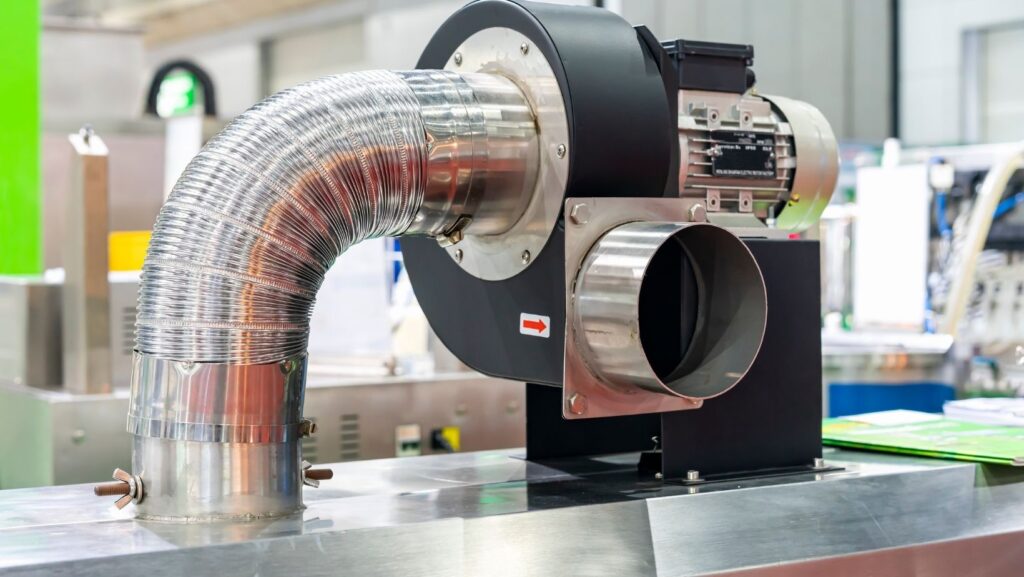
Industrial air handling is one of those unglamorous engineering disciplines that only gets attention when something goes wrong. A production line shuts down because parts aren’t drying fast enough. A quality control checkpoint keeps flagging contamination. An energy audit flags the compressor room as the single biggest draw on the facility’s electrical supply. When those conversations happen, engineers eventually end up in the same place: looking at the blower.
Centrifugal blowers have been the dominant technology in industrial air handling for decades, and for good reason. They move large volumes of air efficiently, they run continuously without the maintenance overhead of alternatives, and they scale well across a wide range of applications. But the engineering behind why they perform the way they do is worth understanding, especially as industrial facilities face increasing pressure to reduce energy consumption without sacrificing throughput.
What Makes Centrifugal Blowers Different
A centrifugal blower accelerates air using a rotating impeller. Air enters axially at the center of the impeller and is flung outward by centrifugal force, exiting at the periphery at higher velocity and pressure. That kinetic energy is then converted to static pressure as the air slows in the volute housing surrounding the impeller.
The fundamental advantage of this design is volume. Centrifugal blowers move air in large quantities at moderate, consistent pressures. That combination is exactly what most industrial blow-off and drying applications actually need, even though many facilities historically used compressed air instead. Well-engineered centrifugal blower systems are designed to deliver this high-volume, moderate-pressure airflow with a compact footprint and low noise signature, making them practical to integrate into existing production lines without major infrastructure changes.
Compressed air systems, by contrast, generate very high pressure through positive displacement compression and then release it through small orifices. That approach works well for tasks that genuinely require high pressure in a confined space, like torque tools or pneumatic cylinders. For blow-off and drying, where coverage area and sustained airflow matter more than raw pressure, the centrifugal approach is inherently more efficient.
The Energy Equation
The energy efficiency advantage of centrifugal blowers over compressed air becomes concrete quickly when you run the numbers. Compressed air systems typically convert only a fraction of the electrical energy input into useful work at the application point. The rest is lost as heat during compression, leaked through distribution infrastructure, and dissipated through pressure regulation.
In one documented steel processing application, a facility was running three compressed air headers with 93 nozzles at 80 PSI to dry steel strip on a production line. Total compressor demand for that single drying step was 468 HP. After switching to a centrifugal blower system with a custom nozzle manifold operating at 2.5 PSI, the total HP requirement dropped by 336 HP. At standard industrial energy rates, that translated to over $131,000 in annual savings per line, before accounting for any reduction in compressor maintenance costs.
The physics behind that result comes down to where the work actually happens. Compressed air at high pressure loses velocity rapidly with distance from the nozzle. Centrifugal blower air, delivered at lower pressure but higher volume through a well-designed outlet, maintains effective velocity over greater distances and across wider surface areas. For a production line drying parts on a conveyor, that means fewer nozzles, less total horsepower, and more consistent coverage.
Sizing and Selection
Matching a centrifugal blower to an application requires understanding three primary variables: the required airflow volume (CFM), the static pressure needed to overcome system resistance, and the temperature requirements of the process.
Airflow volume is driven by the size of the area to be dried or treated and the line speed. A wider conveyor moving faster requires more total air per unit time. Static pressure requirements depend on the resistance in the ducting and outlet system, the distance from the blower outlet to the work surface, and any back pressure from the process itself.
Temperature is where centrifugal blower design gets interesting. The compression process in a centrifugal blower generates a modest amount of heat through adiabatic compression, raising outlet air temperature slightly above ambient. For many drying applications, this incidental heat rise is actually beneficial, accelerating evaporation without requiring a separate heating element. For applications needing more precise temperature control, variable temperature designs can manage outlet temperature through recirculation, while cooled variants bring temperatures down for heat-sensitive processes.
Noise, Footprint, and Maintenance
Three practical factors that often drive purchasing decisions in retrofit applications are noise levels, floor space, and maintenance requirements.
Centrifugal blowers are inherently quieter than compressed air systems running equivalent workloads. The absence of rapid pressure cycling and the smooth rotational motion of the impeller produce a consistent, lower-frequency noise signature that is easier to attenuate with standard enclosures. Well-designed installations routinely achieve below 85 dBA at the work station, which matters both for regulatory compliance and for the quality of life of workers nearby.
Footprint varies by model and HP rating, but centrifugal blowers are generally compact relative to the work they perform. A blower unit delivering the equivalent of 40 HP of compressed air performance can occupy as little as 2 to 3 cubic feet. That compactness matters in facilities where floor space is at a premium and retrofitting around existing equipment is the only option.
Maintenance is perhaps the most underappreciated advantage. Centrifugal blowers have few consumable components. There are no filters requiring frequent changes, no pressure regulators to service, and no lubrication points that require regular attention. Belt-driven models require periodic belt inspection and tensioning, but the overall maintenance burden is substantially lower than the infrastructure required to keep a compressed air system running reliably.
Where the Technology Is Heading
The trend in industrial centrifugal blower design is toward tighter integration with production line control systems. Variable frequency drives (VFDs) allow blower speed and airflow to be adjusted dynamically based on line conditions, reducing energy consumption during slower production runs without requiring manual intervention. Predictive maintenance monitoring is becoming standard on higher-end systems, using pressure and vibration data to flag bearing wear or belt degradation before it causes an unplanned outage.
On the application side, the range of industries adopting centrifugal blower technology continues to expand. Food and beverage processing, pharmaceutical manufacturing, automotive assembly, wire and cable production, and environmental remediation all rely on centrifugal blowers for different tasks, but the underlying engineering requirements overlap significantly. High volume, consistent pressure, clean oil-free air, and reliable continuous operation are universal requirements.
For engineers evaluating air handling options, the centrifugal blower’s combination of energy efficiency, low maintenance, and operational consistency makes it the rational starting point for most industrial drying and blow-off applications. The compressed air infrastructure that replaced it in many facilities over the past several decades is now being re-evaluated as energy costs climb and sustainability targets become binding. The centrifugal blower’s moment of rediscovery is well underway.