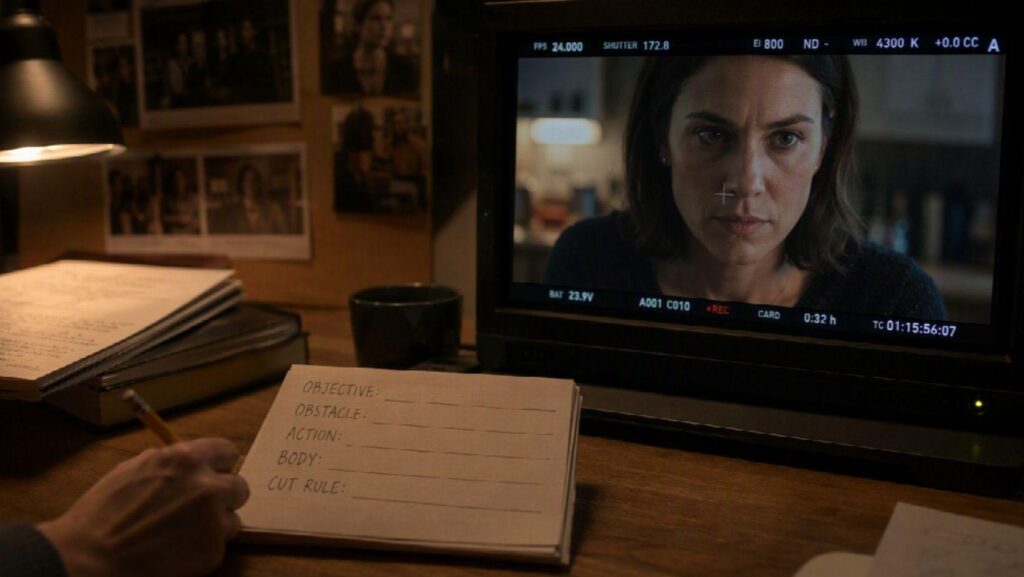
Most AI shorts fail the audition test.
The frames look expensive. The “actor” does not. Eyes float. Hands invent business. Emotion jumps from zero to soap opera between two cuts that were supposed to be the same scene.
Camera coverage can be planned. Character sheets can be locked. Performance is the layer people skip — then blame the model.
This guide is about directing on-screen performance inside Topview Film Studio: emotion beats, micro-behavior, eyelines, and how those notes travel with storyboards and scene generation so the AI executes a directed take instead of a random face.
It is not a Film Studio vs Drama Studio comparison, not a character-continuity bible, and not a camera-axis tutorial. Those problems are real. This one is different: making the person on screen feel intentional.
What “performance direction” means for AI film
In a live set you talk to an actor. In an AI film studio you write direction the generation stack can inherit:
- Emotional target for the beat (restraint, dread, relief — one word is rarely enough)
- Physical behavior that proves the emotion (stillness, delayed blink, jaw set, hands that stop moving)
- Eyeline and address (who they look at, when they look away)
- Intensity curve across the scene (start contained, crack once, recover)
- Do-not-do list (no tears yet, no smile, no looking at camera)
If your prompt only says “cinematic sad woman,” you asked for a stock mood. You did not direct a performance.
Why Film Studio is the right desk for this
A connected film path keeps performance notes next to the decisions that shape them: story beat → board → camera intent → performance → cinematic scene generation. Topview’s Film Studio positioning is explicitly director-led: you still own story, casting, framing, lens, lighting, pacing, and performance while the AI creates images and motion for each beat.
That matters because performance dies when it lives only in the last prompt box. If the board shows a medium two-shot but your generation brief suddenly demands a sobbing close-up, the “acting” will fight the coverage.
A performance-first beat card (steal this)
For every scene beat, fill five lines before you generate:
|
Field |
Example |
|
Objective |
She wants him to admit the lie without crying |
|
Obstacle |
He stays charming; she almost buys it |
|
Playable action |
Soft voice, then one hard stare after his joke |
|
Body |
Hands flat on table; no hair touching; shoulders still |
|
Cut rule |
Emotion peaks on the stare, not on tears |
Pin that card to the beat. Generate against it. If the take invents sobbing, you failed the brief — not “the model is emotional.”
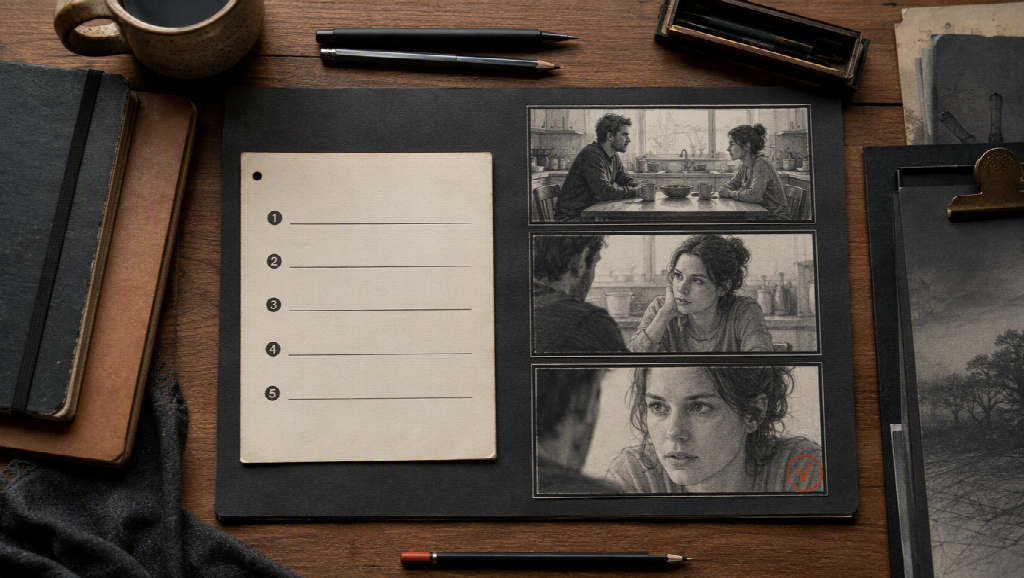 Directing micro-behavior (where AI usually cheats)
AI loves big acting. Microdrama of the face is harder and more cinematic.
Prioritize:
- Onset delay — feeling arrives late; do not start the shot already devastated
- Single tell — one controlled crack (swallow, blink, breath) beats five gestures
- Recovery — let them put the mask back on before the cut
- Listening faces — reaction shots need a task (“she calculates,” not “she looks sad”)
- Hands as character — idle hands invent chaos; give them a prop job or a stillness rule
Film Studio’s performance layer exists so these notes are part of the production path, not a comment you forgot between boards and renders.
How to run performance notes through the Film Studio order
- Story — mark which beats are performance peaks vs plot logistics
- Boards — draw the size of the shot that can carry the acting (wide cannot hold a micro-expression)
- Camera — pick the frame that serves the tell (close for the stare, wider for the refusal to move)
- Performance — write the beat card; lock do-not-do
- Generate — one variable at a time; if acting is wrong, change performance notes before you change the whole world
- Refine — keep the take that obeys the card, even if another take is “prettier”
Pretty that breaks the objective is a failed take.
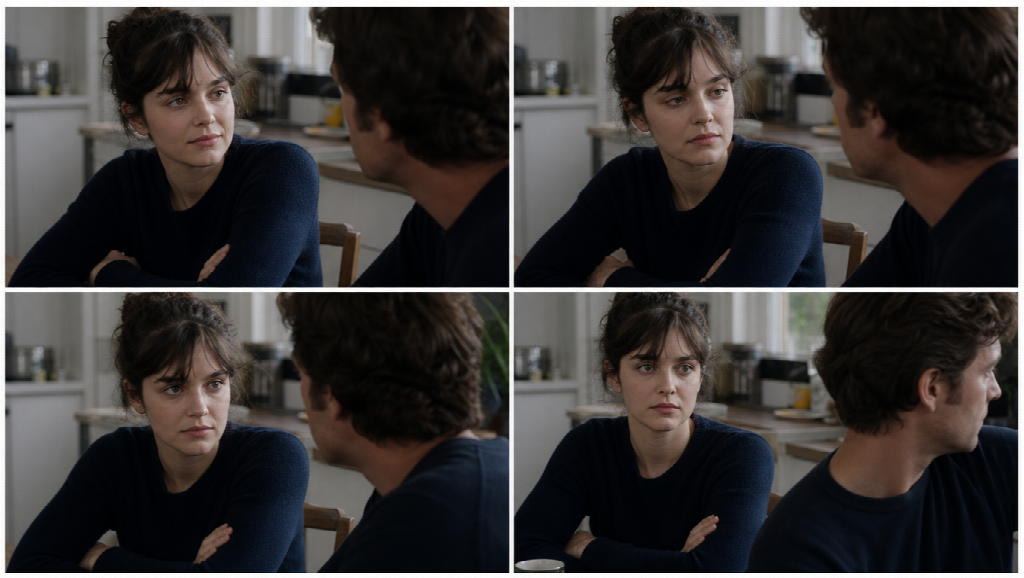 A 90-second scene you can actually direct
Setup: Two people at a kitchen table. He jokes. She knows.
- Beat A (8–12s): Listening face; polite almost-smile; hands still
- Beat B (6–10s): Joke lands; smile dies half a second late
- Beat C (8–12s): Hard eyeline; one line, soft volume; no tears
- Beat D (5–8s): He looks away first; she does not chase
Generate A–D as separate directed units, then cut for listening → delay → stare → win on silence. That cut will feel more “directed” than one 40-second prompt that begs for “emotional cinematic masterpiece.”
Mistakes that kill AI performances
- Asking for tears in every close-up
- Changing wardrobe or age mid-scene while chasing “better acting”
- Directing emotion in the prompt but boarding a profile that hides the eyes
- Regenerating the whole scene when only the onset timing is wrong
- Mixing Drama Studio episodic urgency (hook every five seconds) into a film scene that needs stillness
Stillness is a performance choice. Use it.
Bottom line
AI film gets taken seriously when the face has a job.
Use Film Studio to keep performance direction in the same path as story, boards, and camera — then judge takes by whether they play the objective, not by whether they look like a trailer still. Direct the delay, the tell, and the recovery. Let the model execute. That is how an AI short stops auditioning and starts acting.