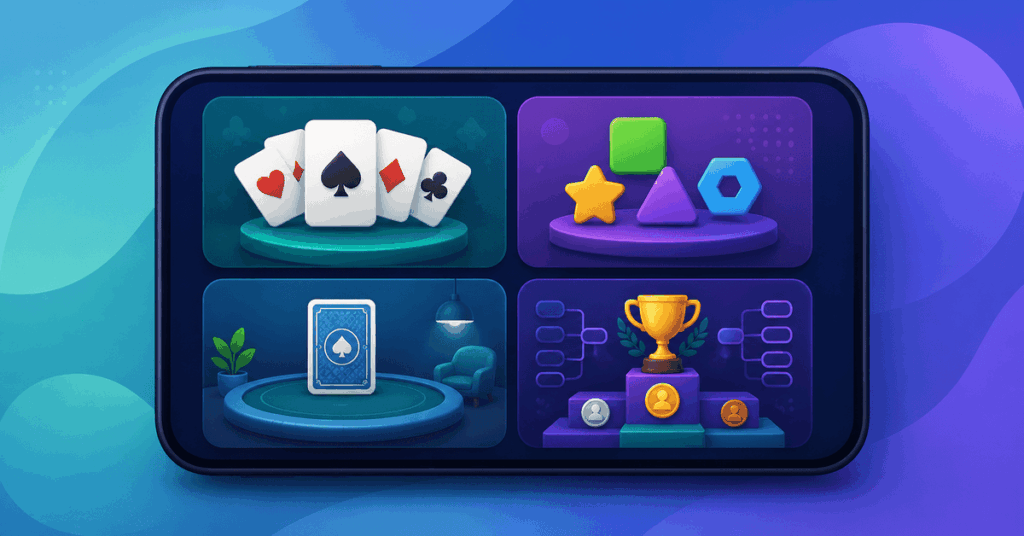
Some apps and websites using Yono-related names organise their game options under labels such as “quick,” “points,” “classic,” “practice,” and “tournament.” These labels may help organise the menu, but they do not always explain exactly how a session is structured.
For example, a quick game may mean a single round on one platform. On another, it may simply use a shorter turn timer or a lower score limit. Points games can also follow different scoring methods depending on the table.
This is because each platform can name and organise its formats in its own way. The same label may describe slightly different rules across different apps.
The number of rounds, participant limit, scoring method, timer, and end condition provide more useful context than the format name alone.
Game Category and Game Format Are Different
A game category tells you the type of activity available. A game format tells you how that activity is organised.
Understanding this difference makes game menus much easier to follow.
What Is a Game Category?
A game category is the broad group that a game belongs to.
Common categories may include:
The category tells you whether the activity involves cards, a board, puzzles, or another type of play.
It does not tell you how many rounds are included, how long the session may last, or how the result will be calculated.
A card-game category on a Yono games platform, for example, may contain several tables that use similar cards but follow different structures.
What Is a Game Format?
A game format explains how a particular game will be played.
It may determine:
The same rummy-style game may be available as a quick table, a points game, a fixed-deal session, a practice mode, or a tournament.
The basic card rules may remain familiar, but the length, scoring, and progression of the session can change.
Why the Difference Matters
A player may already understand how a card game works but still be unfamiliar with the format used on a particular table.
One table may end after a valid declaration. Another may continue for several deals, with scores added after each round. A third may be part of a tournament where players must qualify for the next stage.
The category identifies the game. The format explains how the session is structured.
This distinction is especially useful when switching between Yono games platforms, where familiar format names may be used differently.
Common Game Format Labels Explained
The exact rules depend on the platform, but the following labels appear regularly.
Quick or Single-Round Formats
A quick or single-round format is usually designed to finish within one short session.
The result may be decided as soon as a player completes the required action or meets the stated end condition. Scores generally do not continue into another round.
However, “quick” can mean different things. It may refer to:
A quick table is not always guaranteed to finish within a fixed number of minutes. The actual duration can still depend on how many players are involved and how much time each player takes.
Check the number of rounds and the end condition to understand what “quick” means on that table.
Points-Based Formats
A points-based format is built around a scoring system.
In a card game, points may be calculated from completed combinations, unmatched cards, remaining card values, or penalties. The session usually ends when a player completes the required action or meets the table’s stated condition.
A points-based format should clearly explain:
The “points” label tells you that scoring is central to the format. It does not tell you the exact values or rules being used.
Those details may differ between tables and platforms.
Multi-Round Formats
A multi-round format includes several rounds or hands within one complete session.
Instead of producing a final result after one round, the platform records scores over a series of games. The scores are then combined to determine the final position.
Some formats have a fixed number of rounds. Others continue until a player reaches a particular score or limit.
A weak result in one round does not necessarily end the session. It may only affect the player’s running total. In the same way, winning one round may improve the overall score without deciding the entire match.
Multi-round formats usually take longer than single-round tables because the result depends on performance across several stages.
Fixed-Deal Formats
A fixed-deal format includes a set number of deals or rounds.
Players know in advance how many deals will be played. When the final deal is complete, the platform adds the scores and displays the overall result.
This differs from a format that continues until someone reaches a score limit.
In a fixed-deal game, the session ends because all scheduled deals have been completed. In a score-limit format, it ends when a player reaches the required total.
The table information should state the number of deals and explain how the scores are combined.
Practice or Free-Play Modes
Practice or free-play modes may use automated opponents, guided instructions, longer timers, simplified scoring, or demo credits. These features can illustrate the interface and basic session structure, although they may not reflect the speed or conditions of a standard multiplayer table.
They may include:
A practice table can help you understand where the main buttons are located, how turns are displayed, and how a round ends.
The experience may not be exactly the same as a standard multiplayer session. A live table may move faster and involve players with different styles and levels of experience.
Practice mode is mainly useful for learning the interface and becoming comfortable with the basic structure.
Tournament Formats
A tournament connects several games or rounds within one organised event.
Players may compete across multiple tables, collect points over a set period, qualify for later stages, or progress through an elimination system.
A tournament may include:
Some tournaments begin at a fixed time. Others start when the required number of participants has joined.
The main feature of a tournament is progression. The result depends on performance across several stages rather than one ordinary table.
A Yono games features and formats overview can provide an example of how one rummy-related service organises these options, but its labels and rules should not be assumed to apply to other platforms.
Why Format Labels Differ Between Platforms
No standard naming system applies across all apps and websites using Yono-related names.
Each app can choose its own labels based on how its menu and tables are organised. As a result, two formats with different names may work in a similar way. Two formats with the same name may also follow different rules.
For example:
The name gives you a general idea of the format. The table details explain how it actually works.
Details That Define a Game Format
A few practical details can quickly tell you what kind of session you are joining.
Number of Rounds
Check whether the game ends after one round, continues for a fixed number of rounds, or runs until someone reaches a score limit.
This will give you a basic idea of how long the complete session may take.
Number of Players
Confirm how many participants are required and whether the table can begin before every seat is filled.
The number of players can affect both the pace and structure of the game.
Scoring Method
Look at how points are earned, lost, carried forward, or combined.
This is particularly important in points, multi-round, and fixed-deal formats, where the result of one round may affect the final total.
End Condition
Check what brings the session to an end.
This may be:
Knowing the end condition makes the full structure easier to understand.
Time Limits
Check whether the timer applies to each move, each round, or the entire event.
A shorter turn timer can make a familiar game feel faster and more demanding, even when the scoring rules remain the same.
Format Labels Do Not Identify the Operator
General format names such as “quick,” “points,” “classic,” and “tournament” are used by many different platforms.
Two apps may use the same labels without being owned or managed by the same company. Similar game names, icons, and table formats do not prove that the platforms are connected.
A format name only describes how a game may be organised. It does not confirm who operates the service or where that service is available.
Details about the operator should come from the platform’s own company information, terms, and official support channels.
Conclusion
Game format labels make Yono games platforms easier to navigate, but the name alone does not explain every rule.
Terms such as “quick,” “points,” “multi-round,” “fixed-deal,” “practice,” and “tournament” provide a general idea of how a session is organised. Their exact meaning can still change from one platform to another.
A format is easier to understand when its round count, participant limit, scoring method, timer, and end condition are clearly stated.
Use the format name as a starting point, then read the table details so you know how the session is expected to work.