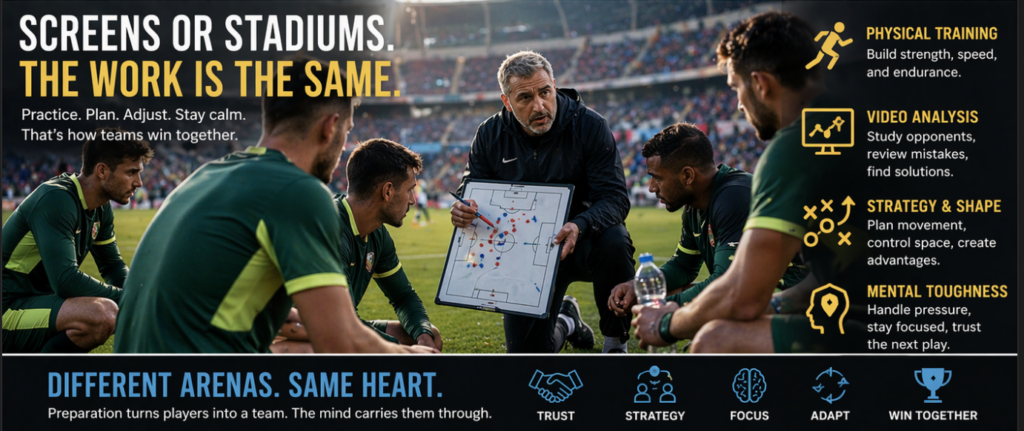
A team does not become strong by chance. It grows through repetition, trust, and long hours of work that most people never see. That is true in esports and in traditional sports too. One team may train in front of screens, while another runs on grass or hardwood, yet both are trying to do the same thing. They want to move well together, think clearly under pressure, and stay calm when the contest turns tight. That is what makes the comparison so interesting. The setting is different, but the deeper work often feels very close.
Training Begins In Very Different Spaces
Traditional sports usually begin with the body. Players run, stretch, lift, and train their movement again and again until it feels natural. An esports team works in a different way. The players sit, watch, react, and repeat patterns with the hand and mind instead of the full body. One team may practice corners, passing, and pressing. The other may practice timing, map control, and quick calls.
Still, both kinds of teams build habits through daily work. They review mistakes, sharpen weak areas, and try to make each player more useful to the group. A football team may study video after training. An esports squad may do the same after a long scrim. The room changes, but the purpose stays very close.
Daily work shapes trust more than talent
Raw skill helps, but trust holds teams together. A gifted striker still needs runners around him. A sharp esports player still needs teammates who read the same moment well. That is why practice is not only about skill. It is also about learning each other. Teams need to know who stays calm, who speaks clearly, and who can still make sense when the pressure rises.
Strategy Changes With The Stage
This is where the biggest difference often appears. In traditional sports, strategy lives in space people can see with the eye. A coach looks at lines, gaps, pace, and physical matchups. In esports, the same idea exists, but it often moves faster and feels less visible to people outside the game. Players are reading maps, timers, angles, and small shifts that may look simple on screen but mean a lot inside the match.
Both sides still rely on planning. A basketball team may want to slow the tempo and protect the paint. An esports team may want to control one side of the map and force mistakes. The names change, but the thinking does not. Both are trying to guide the contest into a shape that suits them best.
Pressure changes the smartest plan
No plan stays perfect once the match starts. A team can prepare for days and still meet something new in the first few minutes. That is why strong teams do more than memorize systems. They learn how to adjust. This is true whether the contest is in a stadium, on a stage, or even in other leisure spaces people know by name, such as online sportsbook platforms, where rhythm and timing still shape how people read moments and choices.
The Mind Often Decides More Than The Setting
Mental preparation matters in both worlds. A football player may hear the crowd and feel the weight of a big miss. An esports player may sit under bright lights and feel the same inner noise after one bad round. The body strain may be different, but the mind strain can feel just as real.
Calm minds carry teams through hard moments
That may be the strongest link of all. Both kinds of teams need players who can reset after a mistake, stay focused, and trust the next moment. Screens and stadiums are not the same, but strong preparation in both worlds comes down to shared work, smart strategy, and steady minds. That is what turns a group of skilled people into a real team.