Nintendo’s hybrid console era has produced some of the most striking commercial milestones in gaming history, but the Switch 2’s latest quarterly report takes that story somewhere genuinely remarkable. Thirteen months after launch, the Switch 2 has cleared the entire lifetime sales total of the GameCube, a feat that reframes what modern console adoption looks like and raises interesting questions about where the broader interactive entertainment market is heading.
From GameCube Nostalgia to Switch 2 Reality
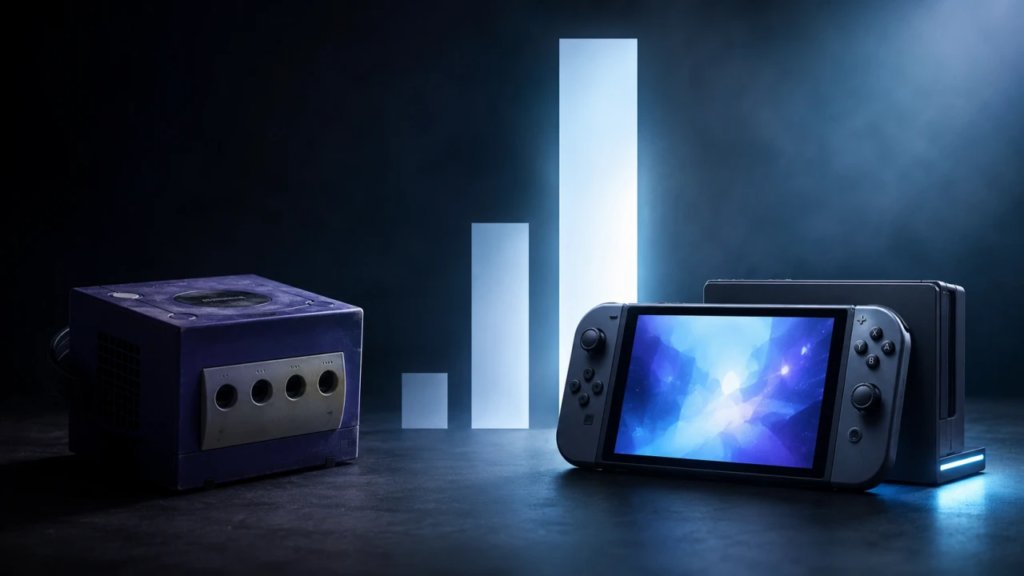
The numbers are stark. Nintendo’s financial results for the quarter ending 30 June 2026 confirm that the Switch 2 has shipped 23.68 million hardware units worldwide since its June 2025 launch, surpassing the GameCube’s complete lifetime total of 21.74 million units. The GameCube spent five years on shop shelves to reach that figure. The Switch 2 did it in just over a year.
That kind of velocity has ripple effects across the whole interactive entertainment landscape. When a single piece of hardware accelerates consumer engagement with digital screens at this pace, every adjacent sector notices, including online casino platforms, which increasingly compete for the same mobile-first audience. Operators like emberbet casino sit in a market that has spent years chasing exactly the kind of seamless, cross-device experience that Nintendo’s hybrid design normalised for millions of players.
The Switch 2’s success also puts its predecessor’s trajectory in perspective. The original Switch had moved 19.67 million units by the equivalent point in its lifecycle. The Switch 2 is running roughly 20% ahead of that, a meaningful gap given that the original Switch went on to become one of the best-selling consoles of all time at 156.59 million units.
What the Sales Numbers Actually Tell Us
Quarter-by-quarter context matters here. The 3.82 million consoles sold in the April-to-June 2026 period represented a 34.4% year-over-year decline, a headline that sounds alarming until you check what it is being compared against. The prior year’s equivalent quarter was the Switch 2’s launch window, full of pent-up demand and global sellouts. Measuring any console’s second-year quarter against its own launch quarter almost always produces a cliff-shaped chart.
Software tells a different story. Nintendo shipped 58.17 million game units alongside that hardware, with quarterly software sales up 9.2% year-over-year. That is the signal that matters for long-term platform health: players are buying games at an accelerating rate, which means engagement is deepening rather than cooling.
- Hardware cumulative: 23.68 million units (as of 30 June 2026)
- Software cumulative: 58.17 million units
- GameCube lifetime total cleared: 21.74 million units
- Gap versus Switch 1 at same point: +4.01 million units (+20%)
Why the Hybrid Format Changed Everything
The GameCube’s commercial struggles were partly a product of its positioning. It was a home console that asked players to sit in front of a television, a perfectly reasonable expectation in the early 2000s, but one that left it exposed once handheld devices began fragmenting attention. Nintendo learned that lesson with the DS, refined it with the 3DS, and then applied it at scale with the original Switch.
The Switch 2 inherits a platform design that removed the friction between home and portable play entirely. That flexibility resonates far beyond traditional gaming demographics. Commuters, students, and adults who might previously have considered a dedicated home console an impractical commitment found a device that slotted into existing daily routines.
This is the same behavioural shift that has driven mobile-first thinking across interactive entertainment more broadly. The iGaming sector has tracked an almost identical pattern: according to data from the IMARC Group, the UK online gambling market reached USD 9.0 billion in 2025, with mobile adoption and internet penetration cited as the primary structural drivers.
The Mobile-First Audience Is Now a Mainstream Audience
The Switch 2’s commercial arc is not happening in isolation. The broader behavioural shift is reshaping how every screen-based entertainment category thinks about product design and audience reach. The line between “console gamer,” “mobile gamer,” and “online entertainment user” has dissolved for a significant chunk of the population, and platforms across sectors are designing for people who move fluidly between screens and contexts rather than those who sit at one device all evening.
For iGaming operators, this convergence is both a tailwind and a design challenge. Live dealer products, instant-play casino apps, and sports betting interfaces have all been rebuilt around the assumption that users will arrive via a phone or tablet rather than a desktop browser. The players who grew up with the original Switch are now among the core demographic for these products, and their expectations around responsiveness, visual quality, and session flexibility are considerably higher than those of earlier online gaming cohorts.
The Bigger Picture for Nintendo’s Roadmap
According to Hardware Busters, the Switch 2 is tracking materially ahead of the original Switch at every comparable milestone. With the holiday quarter still to come and a software slate that includes major first-party titles, Nintendo’s full-year target of approximately 15 million units for the fiscal year looks achievable, despite the year-over-year quarterly optics.
The UK gaming market posted revenues of £5.4 billion in 2025, up 7.4% year-on-year, with mobile titles generating £1.88 billion, or more than one third of the total, as reported by Gaming and Media News. That data point reframes the Switch 2 milestone: the hardware record is not just a Nintendo story, it is a chapter in a larger narrative about how interactive entertainment has restructured itself around devices people already carry everywhere.
The GameCube comparison is useful not just as a milestone marker but as a reminder that console fortunes can swing dramatically based on platform positioning. The GameCube made excellent games; it simply made them for an audience that was harder to grow. The Switch 2, like its predecessor, is designed to grow an audience rather than consolidate an existing one. That distinction is what makes 13 months look like a very short time to rewrite decades of sales history.