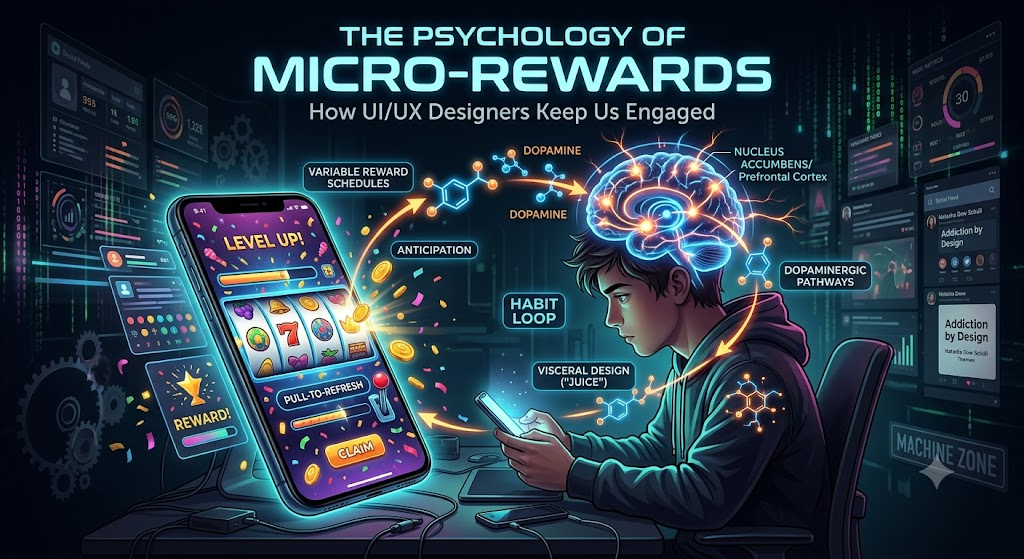
The Attention Casino Is Already Open
Let's be real. The boundary separating your daily productivity tools from a Las Vegas casino floor evaporated years ago. You do not just open an application to check off a task or read the news anymore. Modern interfaces operate as highly engineered behavioral Skinner boxes. Developers meticulously build these ecosystems using the exact same neurochemical triggers that keep desperate gamblers glued to their seats. At the dead center of this attention economy is the micro-reward. A subtle haptic buzz, a burst of colorful pixels, or a sudden notification sound—these tiny acknowledgments hijack your brain's circuitry. We used to design software purely for utility. Now, we design it for compulsion.
Chasing the Machine Zone
App developers study commercial gambling obsessively. The entire industry borrows heavily from anthropological deep-dives detailing exactly how casinos engineer physical environments to maximize time-on-device. Gamblers eventually enter a trance-like state known in the industry as the machine zone. The actual monetary jackpot stops mattering; players just want the continuous, hypnotic feed of micro-interactions to persist without interruption.
Hit a combo on modern digital slot interfaces, and you don't just win money. The screen detonates. Victorious icons shatter; fresh symbols cascade from above while multiplier numbers skyrocket. One lonely tap stretches into a ten-second theatrical production. Check out the infinite scroll on X or TikTok for the exact same blueprint. The code secretly pulls the next video down before your thumb even reaches the glass. It flattens the emotional drop-off, permanently deleting the natural urge to quit.
Things get genuinely sinister once you look at losses disguised as victories. Toss a dollar into a machine, get a quarter in return. Mathematically, you just lost money. The machine, however, screams in victory with flashing lights and celebratory audio. Your sensory system registers a win. Consumer applications do this constantly. Look closer and you will notice those "consolation" badges you get for failing a daily streak, or the hyper-animated partial cashback on a purchase you did not actually need.
The Dopamine Prediction Error
Frankly, pop psychology completely misunderstood dopamine for decades. The general public still thinks it is just a pleasure chemical released when you get what you want. Neuroscientist Wolfram Schultz proved that assumption is entirely backward. Dopamine operates primarily as a prediction signal. His research on the Reward Prediction Error revealed that our neurons fire hardest during the anticipation of an uncertain reward, not the actual receipt of it. If you get a highly predictable point every single time you buy a coffee, your brain flatlines. Absolute predictability breeds total neurological habituation.
Skinner figured this out in the mid-20th century with variable ratio reinforcement schedules. Unpredictability is the real drug. Every single time your thumb launches that dating app or checks a fluctuating crypto wallet, you just yanked the arm of a slot machine. The outcome is completely shrouded in mystery. It might be a massive crypto bull run, a date for Friday night, or absolute static. That engineered randomness is the actual product. A sudden, high-value payout triggers a chemical flood so violent that the behavioral loop practically burns itself into your gray matter.
Brain chemistry drastically alters this dynamic for neurodivergent folks. People navigating ADHD possess a biological requirement for intense novelty. Hand them a static, hyper-predictable dashboard, and the lack of stimulation registers almost like physical pain. These users require immense variance and visceral feedback just to maintain baseline focus, which forces platforms to design incredibly complex, constantly shifting reward architectures.
Squeezing Juice from the Screen
Structural math keeps you hooked, but the sensory delivery of that math is what makes an application feel alive. In professional game development, engineers call this qualitative sensation "game feel" or "juice." A juicy interface reacts to your input with aggressive, instantaneous feedback. Independent developers proved long ago that simple vector graphics become insanely addictive when you add screen shake, elastic physics, and dynamic particle systems. Today, state-machine animation engines like Rive allow UI designers to bake this visceral game feel directly into everyday consumer apps without destroying your battery life.
Visual celebrations are the most obvious culprit in this ecosystem. You submit a quarterly tax payment, clear your inbox to zero, or finish a language lesson, and the screen instantly erupts in physics-based digital confetti. Duolingo essentially wrote the textbook on this specific manipulation. Fail a simple Spanish translation, and the mascot visibly cries in front of you. A perfect score, however, triggers an immediate on-screen festival. Educational developers essentially hijacked the agonizing friction of studying and shoved it through the filter of a hyperactive video game.
Audio cues and haptic taps lock the psychological trap shut. That specific, heavy "swoosh" of a sent email or the deep "ding" of closing a fitness ring operates purely as a conditioned Pavlovian trigger. A synchronized sound paired perfectly with a physical vibration in the phone chassis makes the digital world suddenly feel heavy and tangible in your palm.
The Pull-to-Refresh Trap
The pull-to-refresh mechanic started as a purely practical fix. A developer named Loren Brichter built it back in 2009 because his third-party Twitter app lacked the screen real estate for a clunky refresh button. He accidentally created the most devastating behavioral conditioning trigger of the mobile era. You drag your thumb down. The screen resists slightly. An animated wheel spins briefly to manufacture a fake processing delay. In that manufactured half-second of suspense, human brain chemistry goes completely haywire with anticipation. The mechanics perfectly mirror the physical resistance and anticipation of pulling a casino lever. Brichter himself has since expressed profound regret over his invention. Despite massive ethical pushback from design ethicists, major tech companies refuse to abandon the pattern. It simply prints too much money to ignore.
Fintech companies weaponized this exact architecture to gamify retail investing. Robinhood pushed real-time, highly volatile notifications to casual users, treating serious equity trading like a casual mobile game. The decentralized web copied this playbook verbatim. Early Web3 protocols failed miserably because they demanded slow, rational thought. Eventually, developers pivoted to dopamine-driven design, utilizing massive, randomized token airdrops that turned complex financial interactions into a chaotic, highly lucrative lottery.
White Hats, Black Hats, and the Exhaustion Epidemic
Let's face the facts here. You cannot manipulate human psychology indefinitely without facing massive blowback. We are currently living through an epidemic of gamification fatigue. This is the over-justification effect playing out at scale. When a platform aggressively rewards you with digital badges for a task you already enjoy inherently—like running outside or reading—the external reward eventually corrupts your internal motivation. If Strava suddenly stopped giving you "Kudos" from your peers, you might just stop running entirely. Your intrinsic drive gets hollowed out by the algorithm.
Yu-kai Chou’s Octalysis Framework splits these manipulative tactics into White Hat and Black Hat drives. Black Hat techniques rely on scarcity, unpredictability, and loss avoidance. These mechanisms work instantly to drive metrics up. They also leave users feeling manipulated, burned out, and deeply exhausted. Smart technology companies know they have to transition users toward White Hat drives—like actual mastery and social connection—if they want them to stick around long-term.
The Friction We Actually Need
Zero-friction design is currently steering us into a neurological brick wall. Silicon Valley burned ten years aggressively deleting every single behavioral speedbump just to inject algorithmic reward loops. The resulting digital landscape treats every human user like a lab rat trapped in a highly profitable cage.
The real innovation moving forward is not figuring out how to keep human attention hostage. The casino blueprint solved that math problem with terrifying, clinical efficiency years ago. The next massive shift in UX requires something deeply counterintuitive for modern developers. Designers must learn how to rebuild ethical friction. We have to build interfaces that deliver exactly what you need, provide a brief, satisfying micro-reward, and then explicitly force you to close the application and walk away.