The shift from classical to quantum computing is no longer a theoretical debate reserved for physics laboratories. As commercial platforms scale and quantum processors handle complex optimization problems, enterprise technology leaders face an unprecedented inflection point. Major breakthroughs in error suppression and fault-tolerant architecture have accelerated the timeline for practical business deployment. Consequently, the greatest challenge facing enterprise technology today is not the availability of quantum hardware, but a severe shortage of skilled professionals capable of developing applications for it.
For Chief Information Officers, Enterprise Architects, and IT Managers, this talent bottleneck introduces a high-stakes competitive risk. Organizations that delay building internal capabilities risk falling behind as quantum-driven efficiencies reshape fields like financial portfolio optimization, supply chain logistics, cryptography, and molecular modeling. Transitioning an enterprise IT workforce into the quantum era requires moving beyond traditional computer science paradigms and implementing structured upskilling frameworks.
The Paradigm Shift: Why Classical IT Skills fall Short
Classical enterprise computing relies on deterministic binary logic, where bits exist as definitive zeros or ones. IT infrastructure, database management, and software engineering principles have spent decades optimizing systems around these Boolean structures. Quantum computing, however, operates on fundamental principles of quantum mechanics—namely superposition, interference, and entanglement.
In a quantum framework, quantum bits (qubits) exist in a complex state space, enabling algorithms to evaluate massive solution spaces simultaneously. This fundamental difference means that traditional software engineering skills do not automatically translate to quantum algorithm development:
- Non-Linear Problem Formulation: Designing algorithms for quantum hardware requires formulating business challenges as quadratic unconstrained binary optimization (QUBO) problems or linear system operations rather than sequential logical branches.
- Probabilistic Execution: Unlike deterministic code where an input consistently produces the exact same output path, quantum execution is probabilistic. Developers must understand quantum measurement and statistical sampling to extract valid outcomes.
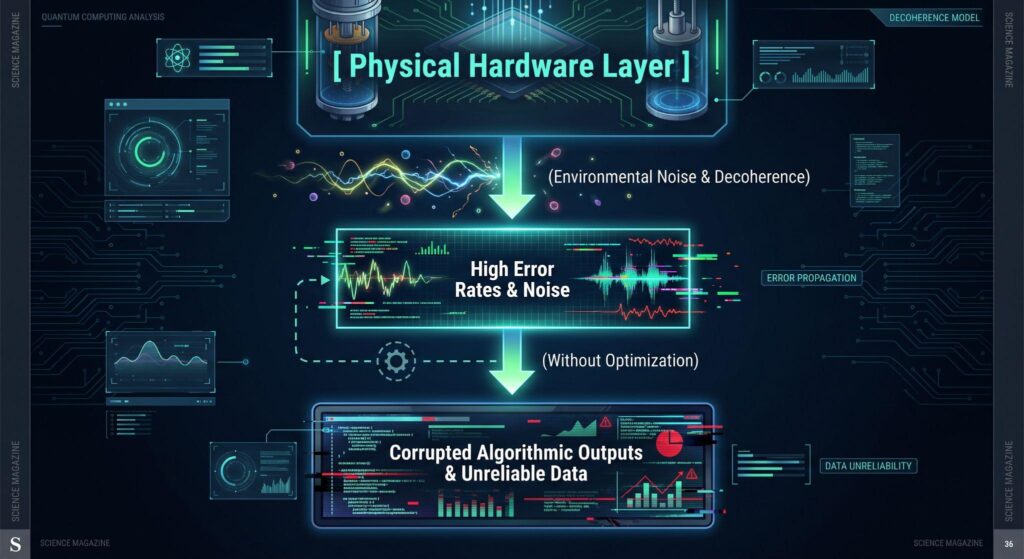
- Hardware-Level Constraints: Current Noisy Intermediate-Scale Quantum (NISQ) and early fault-tolerant systems require deep awareness of gate fidelity, circuit depth, and decoherence times to prevent noise from overwhelming execution results.
Because these principles diverge significantly from standard object-oriented programming, standard software engineering teams cannot simply "pick up" quantum development on the fly. Organizations must establish targeted educational pipelines designed to translate complex physics into practical software execution.
Framework for Organizational Quantum Readiness
Integrating quantum capabilities into an existing enterprise technology stack requires a multi-phased operational roadmap. Organizations must establish clear pathways to move technical staff from basic conceptual literacy to active algorithm deployment.
1. Identifying Enterprise Quantum Use Cases
Before training developers, technology leaders must map quantum advantages to their specific industry verticals:
- Financial Services: Optimization of high-frequency trading portfolios, risk analysis simulations, and real-time fraud detection models.
- Supply Chain & Logistics: Multi-variable route optimization, warehouse allocation, and complex network scheduling via Quantum Approximate Optimization Algorithms (QAOA).
- Cybersecurity: Preparing enterprise encryption infrastructure for post-quantum cryptography (PQC) while exploring quantum key distribution (QKD).
- Pharmaceuticals & Materials: Simulating molecular structures and chemical reactions at an atomic level to drastically reduce R&D cycles.
2. Demystifying the Math Through Interactive Learning
The primary barrier to entry for enterprise developers is the mathematical entry threshold—specifically, linear algebra, complex numbers, and vector spaces. Traditional academic courses often heavy-load these mathematical prerequisites, leading to steep drop-off rates among active software engineers.
Modern enterprise upskilling strategies bypass abstract theoretical barriers through visual, interactive environments. By combining visual circuit building, real-time noise visualization, and hands-on algorithm execution, IT teams build intuitive mental models of qubit interactions. Establishing an accessible quantum computing training foundation enables software engineers and classical developers to quickly transition from baseline physics concepts to programming real quantum hardware.
3. Integrating Quantum and Classical Infrastructure
Quantum Processing Units (QPUs) do not operate as standalone systems; they function as specialized accelerators alongside High-Performance Computing (HPC) clusters and standard cloud servers.
An enterprise-ready quantum team must understand how to orchestrate hybrid workflows. Developers need hands-on experience using industry-standard SDKs to submit quantum circuits to cloud-hosted hardware, manage hybrid classical-quantum loops, and interpret performance metrics.
Overcoming Key Implementation Challenges
Transitioning an enterprise IT department into a quantum-capable organization introduces several distinct operational obstacles:
|
Challenge |
Impact on Enterprise |
Strategic Mitigation |
|
Talent Scarcity |
Hiring PhD-level quantum physicists is cost-prohibitive and unscalable. |
Upskill existing software engineers and system architects using interactive, self-paced software modules. |
|
Rapidly Evolving Hardware |
Architecture standards (superconducting, trapped-ion, neutral atom) remain fluid. |
Train developers on hardware-agnostic software stacks and high-level circuit frameworks. |
|
Noise and Gate Errors |
Raw quantum hardware outputs contain significant environmental noise. |
Implement automated error-suppression tools and teach teams to optimize circuit depth. |
|
Siloed Knowledge |
Quantum initiatives remain isolated within speculative R&D divisions. |
Integrate quantum project goals directly into core business unit innovation roadmaps. |
Actionable Strategy for IT Leaders
To build a resilient, future-proof IT workforce, executive leadership should execute a clear strategy over the next 12 to 18 months:
The transition to quantum computing is an evolution of computational capability, not an instant hardware swap. Organizations that proactively build a quantum-literate engineering culture today will possess the structural advantage required to capture commercial value as quantum systems reach utility scale.