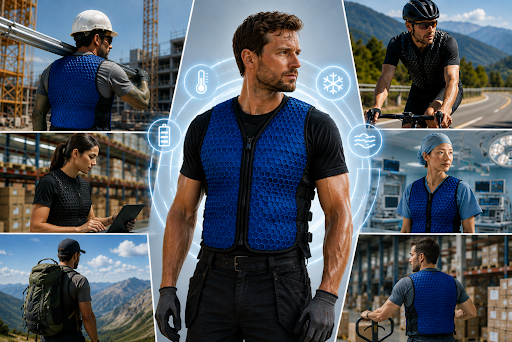
The way people deal with heat is changing. Air conditioning has long been the standard solution for staying comfortable, but it is not always practical. Construction workers cannot carry an air conditioner onto a job site. Cyclists cannot install one on a mountain trail. Event staff, emergency responders, warehouse employees, and athletes often spend hours in environments where high temperatures are unavoidable.
As global temperatures continue to rise and heatwaves become more frequent, attention is shifting toward personal climate control. Instead of cooling an entire room or building, the focus is moving toward cooling the individual. This approach not only improves comfort but also reduces energy consumption while helping people remain productive and safe.
One technology leading this transition is the cooling vest. Once associated mainly with elite sports and specialist industries, cooling vests are becoming increasingly common in workplaces, healthcare, recreation, and everyday outdoor activities. The question is no longer whether they work. Instead, many people are asking whether wearable cooling could become the future of personal climate control.
Why Traditional Cooling Is Not Always Enough
Conventional cooling systems perform well indoors, but they offer little help once people step outside or work in environments without climate control. Heat can quickly affect concentration, endurance, and overall wellbeing. Even moderate heat stress places additional strain on the body as it works harder to regulate its core temperature.
For people whose jobs require physical effort, the consequences extend beyond simple discomfort. Fatigue develops faster, reaction times slow down, and mistakes become more likely. Athletes experience reduced performance, while outdoor enthusiasts often find that hot weather shortens the time they can comfortably remain active.
Cooling the body directly addresses these challenges without depending on large-scale infrastructure.
A Shift Toward Wearable Climate Control
Wearable technology has already transformed how people monitor their health. Smartwatches track heart rate, sleep quality, oxygen levels, and daily activity. The next logical step is clothing that actively supports the body’s natural temperature regulation.
Rather than lowering the temperature of an entire space, cooling apparel focuses on the individual. This targeted approach makes sense because every person experiences heat differently depending on activity level, clothing, humidity, and personal physiology.
Cooling vests represent one of the most advanced examples of this trend. Modern designs are lightweight, comfortable, and available in several technologies that match different environments and applications. Depending on the situation, users can choose evaporative cooling, phase change materials, battery-powered ventilation, or hybrid systems that provide cooling for hours at a time.
More Than Just Comfort
The biggest misconception about cooling vests is that they exist purely for comfort. While feeling cooler is certainly appreciated, the real benefits go much further.
Maintaining a lower body temperature helps reduce physical strain during prolonged activity. When the body spends less energy trying to cool itself, more energy remains available for work, exercise, or concentration.
For workers, this may translate into better productivity throughout long shifts. Athletes often benefit from improved endurance and more effective recovery after training. Healthcare professionals use cooling garments to support patients with heat sensitivity, while emergency services rely on them during demanding operations in protective clothing.
These practical advantages explain why cooling apparel has expanded into so many different industries over the past decade.
Sustainability Plays an Important Role
Personal climate control also offers environmental advantages.
Cooling an entire building consumes considerable electricity, even when only a handful of people occupy the space. Personal cooling reduces the need for aggressive air conditioning by allowing individuals to stay comfortable at higher ambient temperatures.
For offices, warehouses, factories, and public venues, this approach may contribute to lower energy consumption while maintaining employee comfort.
Evaporative cooling technologies are particularly attractive because they require only water rather than electricity during operation. Phase change cooling systems can be reused repeatedly, while newer materials continue to improve efficiency and durability.
As businesses increasingly search for sustainable workplace solutions, wearable cooling aligns well with broader energy-saving initiatives.
Innovation Is Accelerating
Cooling technology has advanced significantly from the bulky ice-filled garments introduced decades ago.
Modern systems use advanced fabrics, engineered phase change materials, intelligent ventilation, and lightweight construction. Some cooling garments can remain effective for several hours, while others are designed for rapid cooling before athletic competition or during recovery periods.
Manufacturers are also developing products tailored for highly specific situations. Firefighters, military personnel, surgeons, industrial workers, and professional athletes all face unique thermal challenges, leading to specialised cooling solutions that maximise performance while remaining practical to wear.
Companies such as Inuteq continue investing in multiple cooling technologies that address different climates, professions, and activity levels instead of relying on a one-size-fits-all solution. Their portfolio illustrates how personal cooling has evolved into a sophisticated field focused on heat stress prevention, comfort, and performance.
Everyday Applications Continue to Expand
Although cooling vests were once considered specialist equipment, they are gradually becoming relevant for ordinary consumers.
Gardeners working through summer afternoons, festival visitors spending entire days outdoors, motorcyclists travelling long distances, hikers exploring warm climates, and commuters facing increasingly hot public transport systems can all benefit from wearable cooling.
Older adults also represent an important group. Age often reduces the body’s ability to regulate temperature efficiently, making heatwaves more dangerous. Personal cooling offers an additional layer of protection during periods of extreme weather.
Even pet owners are beginning to explore wearable cooling products for working dogs and other animals exposed to high temperatures.
As awareness grows, personal climate control is steadily moving into everyday life rather than remaining confined to professional use.
Challenges Still Exist
Despite the progress, cooling vests are not a universal solution.
Different technologies perform better under different environmental conditions. Evaporative cooling works best in dry climates with sufficient airflow, while phase change materials are particularly useful under protective clothing or in humid environments. Battery-powered systems offer active cooling but require charging and maintenance.
Choosing the right technology therefore depends on the intended use rather than selecting the first available product.
Cost also remains a consideration. High-quality cooling garments represent an investment, although many users find the benefits outweigh the initial expense, especially when heat exposure is a regular part of daily life. Discussions among users across sports, construction, and medical communities generally suggest that well-matched cooling vests can provide meaningful relief, provided expectations align with the chosen technology and usage conditions.
Looking Ahead
Personal climate control is likely to become increasingly important as cities warm, outdoor work continues to expand, and more people seek practical ways to stay comfortable without relying entirely on traditional air conditioning.
Future cooling garments may integrate temperature sensors, smart fabrics, biometric monitoring, and automated cooling adjustments that respond to changes in body temperature. Combined with ongoing advances in lightweight materials and wearable technology, cooling apparel could become as common as fitness trackers are today.
Cooling vests already demonstrate that managing body temperature does not require cooling an entire room. Instead, they offer a more targeted, efficient, and adaptable approach that meets the needs of modern lifestyles.
Whether used by athletes striving for peak performance, professionals working in demanding conditions, or individuals simply trying to stay comfortable during increasingly hot summers, wearable cooling is moving from a niche innovation toward a practical everyday solution. If current trends continue, cooling vests may well represent the next major step in the evolution of personal climate control.