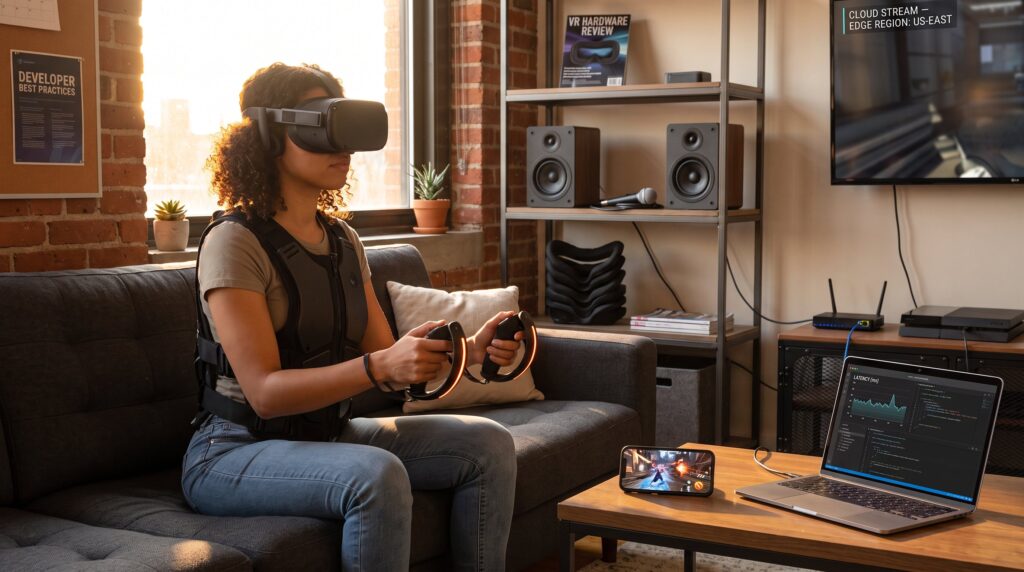
Gaming Technology Trends Worth Understanding leads this guide into 2026 with clarity: cloud streaming, AI content, and immersive hardware are reshaping play and development. Players want lower latency and seamless cross-play. Developers chase scalable services, fair moderation, and richer user journeys. This article gives focused, practical insight for both sides, what to watch, immediate actions to take, and the pitfalls to avoid as these technologies move from experiments to everyday expectations.
Key Takeaways
- Gaming technology trends in 2026 focus on cloud gaming, AI-driven content, and immersive hardware that reshape player experiences and development approaches.
- Cloud gaming enables playing AAA titles on low-end devices, but developers must address latency, input parity, and scalable matchmaking to ensure fairness and performance.
- AI enhances game content creation and personalization, increasing engagement while demanding transparency, ethical practices, and rigorous moderation systems to maintain community trust.
- Immersive technologies like VR, AR, haptics, and spatial audio improve presence but require attention to comfort, affordability, and dual mode support to broaden adoption.
- Players should optimize network quality and device settings, while developers must benchmark real-world conditions, prepare for operational peaks, and maintain transparency to reduce churn.
- Ethical AI use, data privacy, and operational reliability are crucial for sustaining goodwill, requiring audits, human oversight, privacy notices, and robust incident management.
Cloud Gaming, Streaming, And Cross-Platform Play
Cloud gaming and cross-platform play reduce hardware dependence and grow match pools. For players, that means a $12–$20 monthly subscription can stream a AAA title to a phone, tablet, or low-end PC without a high-end GPU. For developers, this means designing for variable latency and fragmented input.
Latency is the clear technical limiter. Players should test network jitter and prefer wired Ethernet for consoles and PCs: a 10–30 ms increase changes aim and hit registration in competitive shooters. Devs must carry out client-side prediction, frame interpolation, and adaptive bitrate streaming. Services that coordinate regional edge servers cut round-trip time by 20–50 ms for many users.
Cross-platform play widens communities but introduces input parity issues, mouse and keyboard versus controller. Developers should design input abstraction layers and matchmaking pools by input type when ranked fairness matters. Publishers experimenting with streaming should plan for scalable matchmaking and account portability.
Practical resources and platform notes are on TurboGeek: readers can consult a short site guide for related tech explainers and how-to posts in the network.
Links in this section: one internal link to a related trend article and one to the Turbogeek pillar page are used in-body.
Related links: see the article on gaming, mobile, digital, casinos, technology, trends for how mobile distribution shapes streaming, and a quick orientation is available through a site overview.
AI-Driven Content, Personalization, And Moderation
AI now generates levels, NPC dialogue, and personalized challenges at scale. That increases replay value and reduces art bottlenecks but raises quality control and ethical risks. Procedural systems can produce a new dungeon in seconds: a trained designer then curates the best 1–3% to avoid nonsensical layouts.
Personalization boosts engagement: adaptive difficulty engines that tune to a player’s 30–60 minute performance window reduce churn by measurable margins in live-service titles. But reliance on behavioral data invites privacy and bias concerns. Teams must log anonymized telemetry and allow opt-outs. Transparency about what is automated helps community trust.
Moderation combines automated classifiers with human reviewers. AI flags 80–90% of toxic messages for review in many deployments, but false positives still frustrate players. Operators should carry out appeal routes and periodic audits of model outcomes. A modest vulnerability: early adopters often underinvest in appeal workflows and see community backlash.
For developers seeking deeper technical practices, TurboGeek’s implementation guides and development case studies provide hands-on tactics and test matrices for AI systems.
Immersive Tech: VR/AR, Haptics, And Spatial Audio
Immersive tech improves presence by layering visual, tactile, and audio cues. VR headsets in 2026 routinely hit 120 Hz and sub-20 ms motion-to-photon latency on flagship devices, which dramatically reduces simulator sickness. AR overlays are shifting from novelty to utility, especially for local multiplayer and location-based experiences.
Haptics add a physical dimension. Low-frequency actuators in controllers reproduce recoil and weight: next-gen vests and gloves convey contact and texture. Spatial audio engines render sounds that change with head orientation and occlusion, making footsteps and gunfire easier to localize.
Adoption still depends on price and comfort. Many players abandon long sessions when devices overheat or straps pinch. Developers should include short-session UX, adjustable comfort settings, and seated-mode fallbacks. Content that supports both traditional displays and headsets, mixed-reality modes, increases reach without doubling production cost.
For hardware comparisons such as motherboards or PC components that support VR-ready rigs, consult neutral hardware reviews before recommending builds to players.
Practical Tips For Players And Developers
Players should prioritize network quality, input compatibility, and device maintenance. A simple checklist: use wired connections when possible, enable QoS on home routers for gaming traffic, update controller firmware monthly, and check that cloud service regions match their geography. One player anecdote: switching from 2.4 GHz Wi‑Fi to wired cut his input lag by 22 ms and stopped missed shots in ranked matches.
Developers should benchmark across real-world networks. Test on 5–20 ms, 30–80 ms, and 100–200 ms conditions and design fallback mechanics for high-latency users. Carry out multiple input mappings and record deterministic replays so support teams can reproduce reported issues. Outsource a portion of live moderation to trained contractors while automating triage.
Operationally, plan server costs with a buffer: initial live launches frequently underpredict peak concurrency by 30–60%. That configuration error leads to queueing and refunds. Transparent communication and a small credit for affected players reduces churn.
Helpful Turbogeek resources include a practical guide to development workflows and troubleshooting articles that walk through testing and deployment steps.
Ethical, Quality, And Operational Considerations
Ethics and operational quality determine whether new tech creates goodwill or community fractures. Data minimization and opt-in personalization lower legal risk and respect players’ privacy. Teams should publish a simple privacy notice that lists telemetry types and retention windows.
Algorithmic bias appears in match outcomes and content curation. Regular audits using stratified samples, 500–2,000 sessions per audit, reveal skewed outcomes before they escalate. Quality assurance requires human-in-the-loop checks: sample 2–5% of AI outputs weekly and log correction rates.
Operational reliability ties to business outcomes. Uptime SLOs of 99.9% limit downtime to under 45 minutes monthly: many successful live titles target 99.95% or higher. Budget for edge nodes, regional redundancy, and a small on-call roster to handle incidents.
Dev teams that share incident postmortems and clear remediation steps rebuild trust quickly. Readers can find templates and postmortem checklists in the site’s how‑to archive.
Hardware, UX, And Adoption Advice
Hardware and UX are the gatekeepers of adoption. Affordable headsets under $300 broaden early uptake: battery life under two hours stops longer sessions. Ergonomics matter, replaceable face cushions and modular straps lengthen usable life and reduce returns.
Developers should design graceful degradation: lower texture resolution, simplified physics, and reduced NPC count on weaker devices to maintain frame rate targets. On mobile, battery profiling that limits background CPU bursts can extend play by 30–45 minutes per session.
For players building or upgrading rigs, choose motherboards and components that match upgrade paths. Neutral hardware reviews help pick reliable parts. One practical step: target a GPU with a two‑generation headroom to avoid repurchasing within 18 months.
Useful Turbogeek reading on AR/VR market changes and development trends helps teams plan budgets and roadmaps.
Conclusion
Adoption in 2026 depends on performance, accessibility, personalization, and dependable multiplayer. Players gain choice: stream or own, controller or touch, solo or cross-play. Developers must prioritize latency, ethical AI use, and device-inclusive UX. Smart teams will instrument metrics, run frequent audits, and keep a human touch in moderation, those choices determine whether technology enhances play or fragments communities.