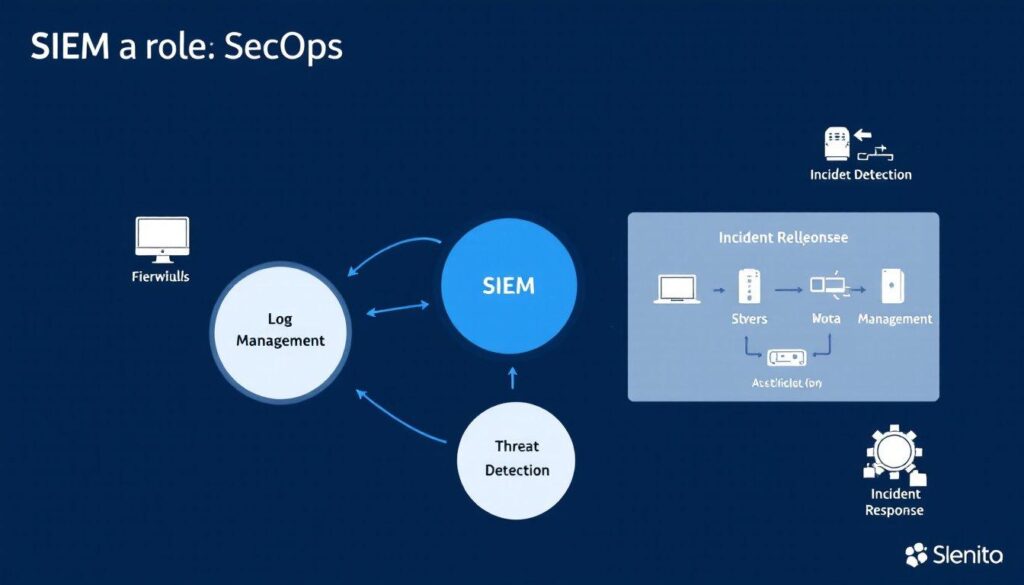
SIEM has been declared obsolete more than once, yet security operations teams keep relying on it. Why? Well, the reason is fairly practical: alerts without context don’t help analysts make faster decisions. A SIEM solution gives SecOps a central place to connect identity, endpoint, network, cloud and application activity, turning isolated records into evidence that can be investigated.
Its value, however, depends far less on the number of logs collected than many organizations assume. The real test is whether analysts can use that information to identify meaningful activity, establish scope and act before a technical incident becomes a costly business interruption. That’s where a well-managed SIEM program earns its place.
What SIEM Brings to Security Operations
Security Information and Event Management, or SIEM, collects telemetry from systems such as identity services, endpoints, network controls, cloud workloads and business applications. It also normalizes those records, correlates related activity, and presents analysts with searchable evidence and prioritized alerts.
The result, therefore, isn’t automatic security but operational visibility.
For a SOC, that visibility supports four jobs:
A modern SIEM for SecOps teams should also fit hybrid estates where logs arrive in different formats, at different speeds, and with wildly different levels of detail.
Detection Through Correlation
A failed login isn’t necessarily interesting. But hundreds of failures followed by a successful privileged login, a new mailbox rule and unusual outbound traffic certainly might be.
Now, correlation can join these weak signals into a stronger one: rules can look for known sequences, and behavioral analytics can flag activity that departs from a baseline. However, analysts still need to ask whether the logic reflects their environment, though. A generic rule copied into production often creates more queue depth than protection.
Faster Triage and Investigation
During triage, the first questions are blunt: Which user? Which asset? What changed? Is the activity still happening?
SIEM solutions shorten this hunt for those answers by placing identity, host, network and cloud records on a common timeline. Analysts can then pivot from an alert to related activity without opening five consoles and manually matching timestamps.
As a result, it saves minutes during an ordinary case and, during a serious intrusion, it may save hours.
Additionally, it also improves hand-offs. For instance, a Level 1 analyst can attach the query, affect entities, and supporting events before escalating, rather than sending a vague ticket marked “suspicious”.
Evidence for Response and Recovery
Containment decisions carry business cost. It means disabling a service account might stop an attacker, or it might interrupt payroll, but SecOps needs enough evidence to act with confidence.
Now, retained logs help establish scope, sequence, and dwell time and also support recovery checks:
- Did the same technique reappear?
- Were credentials used after reset?
- Did traffic return to the suspected destination?
The UK National Cyber Security Centre’s logging and monitoring guidance explains how good logging helps organizations trace events, investigate incidents, and react to early signs of compromise.
How to Build a SIEM Solution That Analysts Can Actually Use
A SIEM deployment can be technically healthy while the SOC remains miserable. Storage is filling, connectors are green, and dashboards look polished, yet analysts don’t trust the alerts. It usually means that the operating choices need work.
Start With Risk Questions, Not Every Available Log
Ask what the team must be able to detect and investigate. Privileged-account abuse? Cloud control-plane changes? Data movement from a regulated system? Those questions determine which telemetry deserves early attention.
|
Priority data source |
What it can reveal |
Practical SecOps consideration |
|
Identity and authentication logs |
Brute-force attempts, unusual sign-ins and privilege misuse |
Correlate users across directories, cloud services and privileged accounts |
|
Endpoint security records |
Suspicious processes, malware activity and persistence attempts |
Account for devices that are offline, unmanaged or missing an active agent |
|
Firewall, DNS and proxy logs |
Unusual connections, blocked traffic and suspicious destinations |
Watch ingestion volume and retain enough detail for investigation |
|
Cloud audit logs |
Configuration changes, new credentials and control-plane activity |
Check that every account, subscription and region is covered |
|
Application and database logs |
Access to sensitive records and unusual transactions |
Prioritize systems according to business impact and data sensitivity |
The Australian Signals Directorate advises organizations to tailor collection to their environment and add sources gradually rather than ingesting everything at once. Its priority-log guidance for SIEM ingestion offers a useful starting point for risk-based planning.
Treat Data Quality as a Detection Control
A SIEM solution can’t correlate events reliably if clocks drift, hostnames change without mapping, user identities aren’t resolved, or a connector silently drops records. Also, monitor ingestion health as closely as alert volume.
Useful checks include source coverage, parsing failures, timestamp accuracy, event latency, and abrupt volume changes. So, assign an owner to each high-value source; otherwise, a broken feed tends to remain somebody else’s problem until an incident exposes the gap.
Tune Around Outcomes
What makes a good alert? Not novelty. It should identify a plausible security condition, carry enough context for a first decision, and point to an action the team can take.
Here, focus on appointing analysts who can review and close the noisy rules, suppress known benign behavior carefully, adjust thresholds, and add asset or identity context.
Also, don’t judge detection engineering only by the number of rules shipped because better measures include true-positive rate, time to triage, cases reopened, and incidents detected through more than one signal.
Automate Carefully
Automation can enrich an alert, check reputation, open a case, or collect host details with little operational risk. Automated containment, however, is different because blocking an address or disabling an account without guardrails can turn a false positive into an outage.
Start with repeatable enrichment and evidence gathering, and for response actions, define confidence thresholds, approval paths, and rollback steps. After that, test them under pressure, not just in a quiet workshop.
Choosing and Governing a SIEM Solution
Product evaluation should follow the operating model. It means:
- Can the platform ingest the sources that matter without brittle custom work?
- Can analysts query historical data at incident speed?
- Are detection rules versioned, tested, and portable?
- What happens to cost when cloud telemetry doubles?
At the same time, examine access controls, log integrity, retention tiers, data residency, and administrative audit trails. Compliance may set a minimum retention period, but investigation needs should shape what stays searchable.
Also, keeping everything in an expensive hot tier isn’t automatically prudent; neither is archiving evidence the SOC can’t retrieve quickly.
Ownership needs similar clarity. Platform engineering may run collectors, detection engineers maintain logic, and incident responders consume the output. But someone must still be accountable for coverage gaps, rule reviews, and connector failures across those boundaries.
SIEM Works When It Improves Decisions
The business case for a SIEM solution isn’t a larger alert count or another executive dashboard. It’s the ability to recognize material activity sooner, assemble defensible evidence, and make containment choices before technical disruption becomes business loss.
That outcome, therefore, depends on disciplined scope. Focus on collecting records tied to priority risks, keep the data trustworthy, tune detections with the people who investigate them, and automate only where failure is tolerable. When those habits are in place, SIEM becomes more than a log repository. It becomes working memory for SecOps, especially on the difficult days when nobody has time to search from scratch.